Tous les posts dans la catégorie 'Impérialisme'

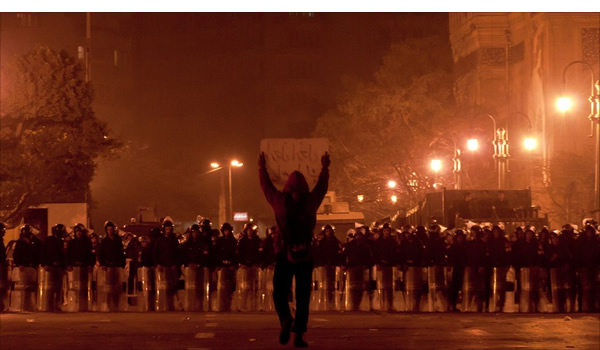
A People’s History of the Egyptian Revolution

egypt-protest-night1

    By: Rami El-Amine and Mostafa Henaway

No matter how it unfolds, the Egyptian revolution will go down in the history books as a defining moment in the 21st century. Millions of Egyptians brought down one of the world’s most repressive regimes, that of the U.S.-backed Hosni Mubarak, in just 18 days. Their bravery, perseverance, and tactfulness in the face of the regime’s brutal crackdown not only triggered uprisings across the Arab world but inspired and influenced protests against government austerity in the U.S., Spain, Portugal, and Greece. Despite the fact that it is only a few months old, it’s important to begin piecing together a people’s history of the revolution to convey what happened and how it happened so that the lessons from this critical struggle can be disseminated.
(Lire la suite…)

Don’t ‘No-Fly’ Libya

5 mars 2011 | Posté dans Libya, Impérialisme
    March 4, 2011 – by Phyllis Bennis, Institute for Policy Studies (IPS)

tadamonlibya

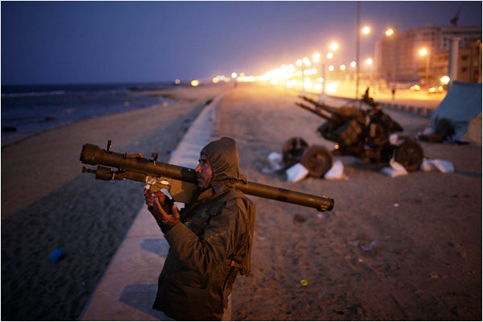
Photo: A member of the opposition prayed for safety as he stood guard near the Mediterranean Sea in Benghazi. He held a surface-to-air missile launcher to protect the rebels from incoming planes.

What would a no-fly zone in Libya mean? A bit of history may provide some perspective.

Today in Libya, civilians are being killed by a besieged and isolated dictator. Libyan warplanes have been used to attack civilians, although the vast majority of the violence has come from ground attacks. The Libyan opposition’s provisional national council, meeting in Benghazi, is debating whether they should request military support from the international community, maybe the UN or NATO, starting with a no-fly zone. The Arab League announced that it was also considering establishing a no-fly zone, perhaps with the African Union.

(Lire la suite…)

Égypte : la classe moyenne pour la junte militaire, les travailleurs pour la Révolution permanente

16 février 2011 | Posté dans Égypte, Impérialisme, Solidarité
    par Hossam el-Hamalawy, Arabawy 12 février.

tadamonegyptstrike

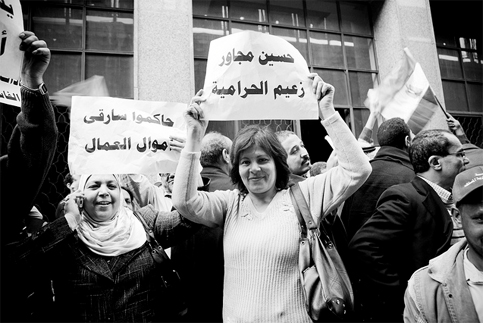
Photo Manifestation au siège de l’état-soutenu Fédération égyptienne des syndicats.

Depuis hier, et en réalité bien avant, les militants de la classe moyenne exhortent les Égyptiens à suspendre les manifestations et à retourner au travail, au nom du patriotisme, leur chantonnant quelques-unes des berceuses les plus ridicules du genre « Construisons une nouvelle Égypte », « Travaillons encore plus dur qu’avant », etc. Au cas où vous ne sauriez pas qu’en réalité, les Égyptiens sont déjà parmi les peuples qui travaillent le plus dur dans le monde.

Ces militants veulent que nous fassions confiance aux généraux de Moubarak pour une transition vers la démocratie – la même junte qui lui a fourni l’ossature de sa dictature toutes ces trente dernières années. Et si je crois qu’effectivement le Conseil suprême des Forces armées, qui tous les ans reçoit des USA 1,3 milliard de dollars, va finir par manigancer une transition vers un gouvernement « civil », je suis sûr aussi que ce sera un gouvernement qui assurera la continuité d’un système qui ne touchera jamais aux privilèges de l’armée, qui maintiendra les forces armées comme l’institution qui aura le dernier mot en politique (comme par exemple, en Turquie), qui garantira que l’Égypte continue d’appliquer la politique étrangère états-unienne qu’il s’agisse d’une paix non désirée avec l’État d’apartheid d’Israël, d’un passage assuré à l’US Navy dans le Canal de Suez, de la continuation du siège de Gaza ou de l’exportation du gaz naturel en Israël à des taux subventionnés. Un gouvernement civil, ce n’est pas un gouvernement constitué de membres qui ne portent pas d’uniformes militaires. Un gouvernement civil, cela veut dire un gouvernement qui représente pleinement les exigences et les désirs du peuple égyptien sans aucune intervention des galonnés. Et je vois cela comme quelque chose de très difficilement admis, et encore moins mis en oeuvre par la junte.

(Lire la suite…)

Anti-Israel economic boycott gaining speed

5 octobre 2010 | Posté dans Boycott, Palestine, Économie, Impérialisme
    Haaretz by Nehemia Shtrasler September 2010

APTOPIX MIDEAST ISRAEL PURIM

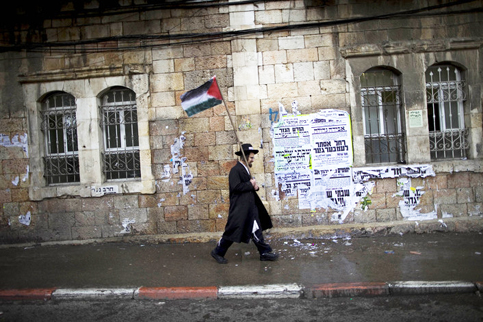
Photo Oded Balilty An ultra-Orthodox Jewish man carries a Palestinian flag as he walks in the street during the Purim holiday in Jerusalem, Monday, March 1, 2010.

The entire week was marked by boycotts. It began with a few dozen theater people boycotting the new culture center in Ariel, and continued with a group of authors and artists publishing a statement of support on behalf of those theater people. Then a group of 150 lecturers from various universities announced they would not teach at Ariel College or take part in any cultural events in the territories. Naturally, all that spurred a flurry of responses, including threats of counter-sanctions.

(Lire la suite…)

Formalizing Israel’s Land Grab

18 août 2010 | Posté dans Palestine, Économie, Impérialisme
    TruthDig by Chris Hedges, Aug 16, 2010

tadamonpalestiniankidmilitary

    Photo: Palestinian child standing close to Israeli occupation soldiers in West Bank.

Time is running out for Israel. And the Israeli government knows it. The Jewish Diaspora, especially the young, has a waning emotional and ideological investment in Israel. The demographic boom means that Palestinians in Israel and the occupied territories will soon outnumber Jews. And Israel’s increasing status as a pariah nation means that informal and eventually formal state sanctions against the country are probably inevitable.

(Lire la suite…)

Déclaration de solidarité de Tadamon! Avec Al Adab Magazine

6 août 2010 | Posté dans Beirut, Culture, Iraq, Lebanon, Palestine, Impérialisme
    Août 2010, Montréal, Québec

tadamonbeirutskylinenew

    Photo des immeubles de Beyrouth en avion au-dessus de la Méditerranée.

Le collectif Tadamon aimerait exprimer son entière solidarité avec M Samah Idriss, éditeur d’Al Adab (« littérature ») Magazine.

Au sujet de Al Adab

Depuis sa création en 1953, cet important magazine de culture Arabe a joué un rôle clé dans l’encouragement de la pensée progressiste et de la création d’espace de débat dans le monde arabe.

Publié à Beyrouth, capitale libanaise, le magazine Al Adab est devenu un point central favorisant la réflexion critique sur les mouvements démocratiques locaux, mais aussi un espace où les militants peuvent dénoncer aussi bien la colonisation que la dictature à travers tout le Moyen-Orient.

(Lire la suite…)

The End of (Military) History?

31 juillet 2010 | Posté dans Palestine, Impérialisme
    Andrew Bacevich July 29th 2010 Huffington Post

090126-almeghari

    Photo Palestinian UN school bombed by Israeli military in Gaza.

“In watching the flow of events over the past decade or so, it is hard to avoid the feeling that something very fundamental has happened in world history.” This sentiment, introducing the essay that made Francis Fukuyama a household name, commands renewed attention today, albeit from a different perspective.

Developments during the 1980s, above all the winding down of the Cold War, had convinced Fukuyama that the “end of history” was at hand. “The triumph of the West, of the Western idea,” he wrote in 1989, “is evident… in the total exhaustion of viable systematic alternatives to Western liberalism.”

Today the West no longer looks quite so triumphant. Yet events during the first decade of the present century have delivered history to another endpoint of sorts. Although Western liberalism may retain considerable appeal, the Western way of war has run its course.

(Lire la suite…)

Revealed: how Israel offered to sell South Africa nuclear weapons

24 mai 2010 | Posté dans Palestine, Impérialisme
    guardian.co.uk by Chris McGreal Sunday 23 May 2010

tadamondocumentssouthafricaisrael

Photo Documents on nuclear warheads between apartheid South Africa and Israel

Secret South African documents reveal that Israel offered to sell nuclear warheads to the apartheid regime, providing the first official documentary evidence of the state’s possession of nuclear weapons.

The “top secret” minutes of meetings between senior officials from the two countries in 1975 show that South Africa‘s defence minister, PW Botha, asked for the warheads and Shimon Peres, then Israel’s defence minister and now its president, responded by offering them “in three sizes”. The two men also signed a broad-ranging agreement governing military ties between the two countries that included a clause declaring that “the very existence of this agreement” was to remain secret.

(Lire la suite…)

Montreal : Qui est le Terroriste ?

criminalisation des mouvements sociaux à l’heure de la croisade anti-terroriste

tadamonobeygraphic

    Jeudi le 5 Novembre 2009
    18h30 au Pavillon J-A-DeSève (DS)
    l’UQAM, Salle DS-1580
    320, rue Sainte-Catherine Est
    photo obey

(Lire la suite…)

Obama must match rhetoric with principle

15 octobre 2009 | Posté dans Iran, Iraq, Lebanon, Palestine, Impérialisme, Politique
    George Bisharat, San Francisco Chronicle October 1st, 2009.

tadamonobamablackwhite

    Photo: US President Barack Obama.

US President Barack Obama has placed restoration of the stature of the United States among his primary foreign policy goals. He has already achieved substantial progress in Europe, where polls indicate that he is widely admired. The president’s June Cairo University speech also won praise in the Arab and Muslim worlds. Yet many across the globe still await the substantive policy changes implied by his inspiring words.

President Obama can solidify broader global respect by supporting the recommendations of the just-released Goldstone report in the United Nations Human Rights Council. Richard Goldstone, an eminent South African jurist, led a mission to investigate allegations of war crimes in Gaza last winter.

(Lire la suite…)

Événements à venir

Recherche